Saturday, February 11, 2017

LAD #31 Wilson's 14 Point Plan

Image result for wilson's 14 points


At the conclusion of The Great War, President Wilson drafted a solution that he had hoped would maintain peace with all nations and truly keep to his campaign "A war to end all wars". Wilson's goal was to end the war in a forgiving and charitable way. With this in mind, he came up with the 14 Point Plan. 14 idealistic approaches which he hoped he could maintain postwar. Most important was his last point, the proposition of the League of Nations, a peacekeeping organization with representatives from all nations.

1. Public diplomacy and negotiations
2. Absolute freedom of the seas
3. Removal of economic barriers and creation of equality in trade
4. Reductions by all nations of their armies to the lowest point consistent with public safety
5. Adjustment of colonial claims to the interests of both the inhabitants of the colonies and the colonial powers
6. Russian independence and evacuation of it's territory by other powers
7. Evacuation and restoration of Belgium as independent
8. Evacuation of France and the return of the Alsace-Lorraine territory to France
9. Readjustment of Italian borders
10. Independence of multiple nationalities in Austria-Hungary
11. Evacuation of the Balkan states and allowance for them to be independent along lines of established nationality.
12. Protection of minority states in Turkey and free passage through the Dardanelles by all nations
13. Independence for Poland, including free access to the sea
14. A "League of Nations" should be formed to allow security for large and small powers alike.

Later on, Wilson's 14 points proved to be rather unsuccessful, as the other Allies found them to be too lenient, and they wanted a more severe punishment for their German foes. As a result, he was forced to compromise practically all of his 14 points except his most cherished League of Nations.


Image result for lincoln's ten percent planThis is similar to Lincoln's 14 Point Plan because many were not satisfied with the lenience of the plan, and desired a harsher punishment for the perpetrators.
Wednesday, February 8, 2017

LAD #30 Schenck v. United States

Image result for charles schenck

Charles Schenck, and American Socialist, began spreading posters and mailing draftees about dodging the draft at the start of The Great War. Schenck believed that the draft was a direct violation of the thirteenth amendment, as he interpreted it as demanding "involuntary servitude". He urged his targets to support his cause by petitioning the Conscription Act. Because of this, Schenck was charged with promoting insubordination in the military as well as violating the espionage act, which declared it illegal to interfere with military efforts, war efforts, or recruitment. During the trial, Schneck argued that he maintained the freedom of speech with the first amendment, making his efforts legal. However, the court decided against him in a unanimous decision, saying that in this case he did not maintain freedom of speech as it presented a "clear and present danger". Many recognized that during a war time such as this, the government expanded its power over the people. This decision was later overturned.
Image result for sedition act of 1918The Sedition Act of 1918 limited freedom of speech far past what was normal. It made it illegal to cast one's personal opinion on governmental action. Thousands were prosecuted over this before it was overturned.

Thursday, January 19, 2017

LAD #29 Keating-Owen Child Labor Act

Image result for keating owen child labor act

The Keating-Owen Child Labor Act was passed in 1916 in response to the census of 1900, saying that two million children were working in the United States. The bill was passed based on the power that the government had on the regulation of interstate commerce. Overall, it prevented children under a certain age to work in certain conditions. Children under 16 could not work in mines, at night, or for more than eight hours a day. This was ruled unconstitutional in Hammer v. Dagenhart by the Supreme Court on account of the fact that it overstepped the government's purpose of regulating interstate commerce.


Image result for fair labor standards actThe Fair Labor Standards Act of 1938 also helped create child labor laws, as well as normal labor laws.

LAD#28 Wilson's Inaugural Address

Image result for woodrow wilson

Woodrow Wilson first took office in 1912. In his inaugural address, he discussed the changes that had been occurring in the previous government. The majority of the government representatives at this point were Democratic, meaning the government would be very efficient in passing lows because they shared opinions. Wilson believed that this was a good idea because it was a fresh new ideology to run the country by. He believes that life in America had improved, but there was still suffering, and at times the government would disregard this for economic advancements. He also promises to resolve important issues including the financial system, tariffs, big businesses, workers rights, and sanitation. He believed that with the democratic populous in the government, the country would benefit.


Image result for fdrFranklin Delano Roosevelt was also very successful in getting a lot done with Congress, as both were also democratic.


LAD #27 Clayton's Anti-Trust Act

Image result for claytons antitrust act

The Clayton Anti-Trust Act of 1914 was another action by the government to restrict big businesses. This was created to break up big trusts and monopolies that were harmful for american competition and industry. This act made it illegal to discriminate prices between products and services of similar value if it promoted a monopoly or other big business tactics that were corrupt. This also prevented big businesses and companies holding large portions of certain industries to dramatically change their prices with the intention of driving out competition to create large monopolies. Additionally, other countries could no longer buy large portions of stock of corporations or businesses. Overall, the power of big businesses were weakened, and the power of the federal government was strengthened.

Image result for shermans antitrust actThis is like the Sherman Antitrust Act, that also moved to eliminate trusts and monopolies of big businesses.

Monday, January 16, 2017

LAD #26 MLK's "I Have a Dream" Speech


Image result for martin luther king jr


In Martin Luther King Jr.'s "I Have A Dream" Speech, he begins by referencing the act of former President Abraham Lincoln--sighning the Emancipation Proclamation and freeing the slaves. This was a huge step in the right direction for many African Americans, but according to MLK, they are still not truely free. King lists many issues that African Americans face during this tumultuous time period. He makes the analogy that they are "cashing a check" at the capitol--their right to life, liberty, and the persuit of happiness. He continues the check analogy by saying that they are getting the message that there are "insufficient funds". He encourages his fellow advocats to keep cashing the check because the "bank of liberty cannot go bankrupt". He stresses that the time for change is now, and his acts of civil disobedience will continue until they see change. He restresses that no acts of violence or crime should be committed under the name of equality. Finally, he proceeds to the most well known part of his speech. He has many dreams, like for his children to live in a country that "does not judge them based on the color of their skin, but the content of their character". Lastly he references the famous patriotic song "My Country 'tis of Thee". His dream is for "freedom to ring" everywhere in America.


Image result for aint i a woman speechThis speech is similar to Sojourner Truth's "Ain't I a Woman?" speech because it demands equality and justice for all, not just white men.

Friday, December 23, 2016

LAD #24 Bryan's Cross of Gold Speech

Image result for bryan's cross of gold speech

William Jennings Bryan delivered his famous "Cross of Gold" speech in 1896 at the Democratic National Convention in Chicago, as he was trying to be the party's nominee. This speech regarded his opinion of the silver to gold ratio of 16 to 1 in the American economy. By doing this, farmers in debt would be aided because of an increase of currency in circulation. Bryan considered this to be a humane and just cause for Americans. He prefers to clear the waters rather than fight. He argued that America is a country for the people, and believes that he is representing the general people when he states his goal for the coinage of silver. He also supports distributing wealth and an income tax. He conceded that many city people support the gold standard, but reminded them that wealth comes from the poor.


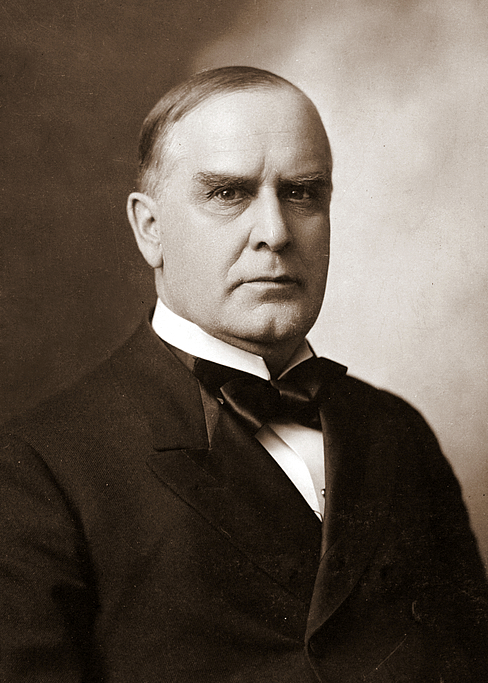
Image result for mckinleyPresident McKinley supported the gold standard, which Bryan opposed, saying "they will crucify us on a golden cross"